The Best Boxing Combinations: 5 Essential Combos You Need to Master
The best boxing combinations include the 1-2 (Jab-Cross), 1-2-3 (Jab-Cross-Hook), 1-2-3-2 (Jab-Cross-Hook-Cross), 1-2-5-2 (Jab-Cross-Lead Uppercut-Cross), and 2-3-2 (Cross-Hook-Cross). These combos work because they attack from multiple angles, keep your opponent guessing, and create openings for power punches.
What are Boxing Combinations?
Boxing combinations are sequences of punches thrown one after another in a flowing motion. A combination is a strategic attack where each punch has a purpose such as to create an opening, distract your opponent, or land a power shot. Good combinations flow together smoothly, with your weight shifting naturally from one punch to the next.
Single punches can be easily read and countered, but boxing combos force your opponent to defend multiple angles, making it more likely that at least one of your punches will land. When you throw a combination, you’re essentially solving a puzzle by using different punches to break down your opponent’s defense piece by piece.
In boxing, we use numbers to represent different punches:
- 1 = Jab (lead hand) – A quick, straight punch used for distance and setup
- 2 = Cross (rear hand) – A powerful straight punch from your back hand
- 3 = Lead Hook – A curved punch thrown with your front hand to the side of the head or body
- 4 = Rear Hook – A curved punch from your back hand, usually targeting the head
- 5 = Lead Uppercut – An upward punch thrown with your front hand, coming from below
- 6 = Rear Uppercut – A powerful upward punch from your back hand
Understanding these basic boxing techniques is key before drilling combinations at speed.
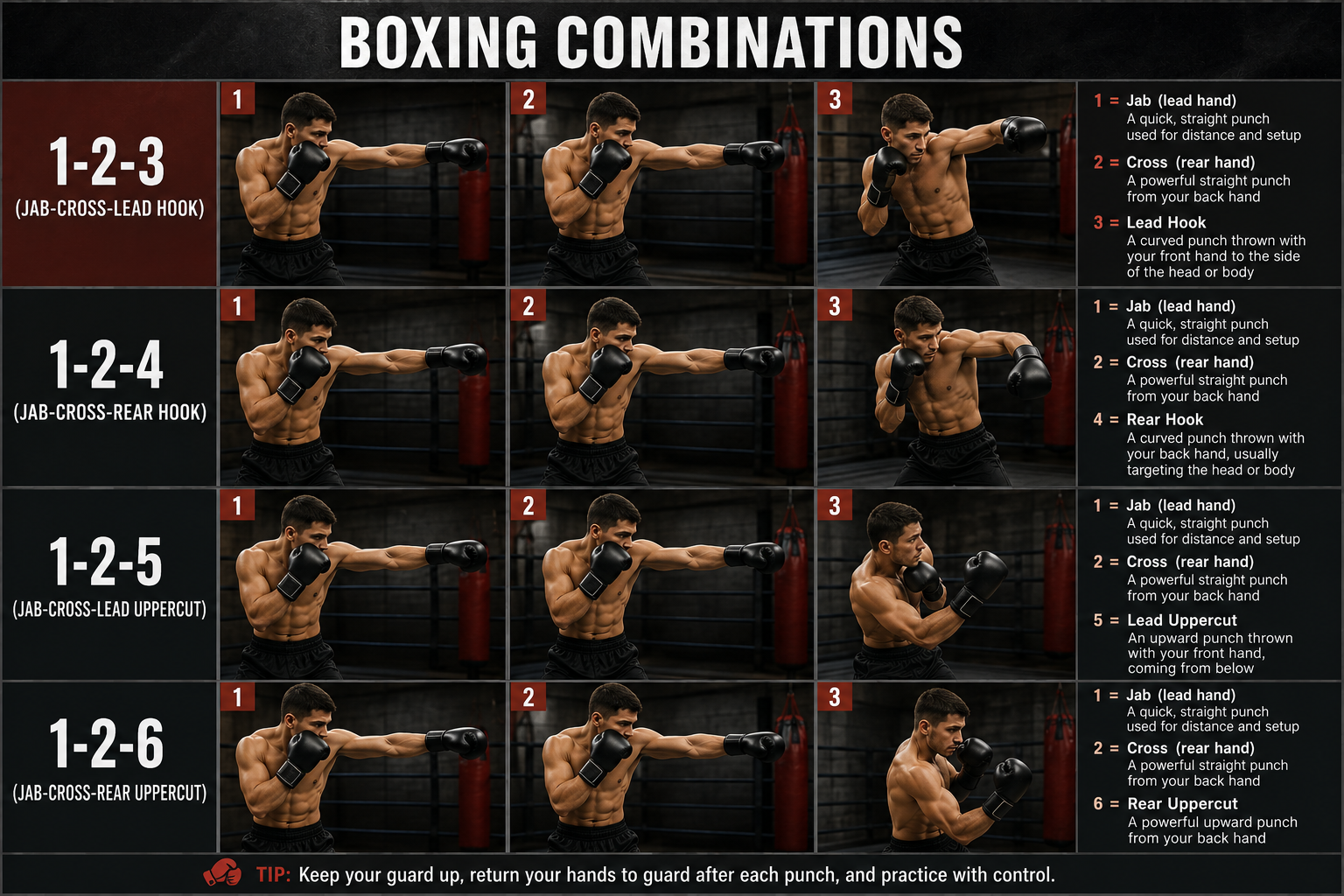
The 5 Best Boxing Combinations
Learning the best boxing combos is essential for any fighter, whether you’re a beginner or an experienced boxer. These five combinations will form the foundation of your offensive strategy.
1. One-Two Combo 1-2 (Jab-Cross)
What it is: A quick jab followed immediately by a powerful cross.
The 1-2 combination is the most fundamental and essential combo in boxing. It’s a one-two punch where you throw a fast jab with your lead hand to create an opening or distraction, then immediately follow up with a powerful straight cross from your rear hand. This combo teaches you the basic rhythm of boxing. The jab measures distance and disrupts your opponent’s defense, while the cross delivers the knockout potential.
How to do it:
- Start in your fighting stance with your guard up
- Snap out a quick jab with your lead hand
- Immediately rotate your hips and throw a straight cross with your rear hand
- Return both hands quickly to guard position
Things to remember:
- The jab sets up the cross by creating an opening
- Keep your chin tucked behind your shoulder when throwing the cross
- The cross should be more powerful than the jab
- Your rear foot should pivot as you throw the cross for maximum power
Rules to follow:
- Don’t drop your hands between punches
- The jab should be fast; the cross should be powerful
- Always return to your guard after finishing
This is the most fundamental combo in boxing. Master this before moving on to more complex combinations.
2. The 1-2-3 (Jab-Cross-Lead Hook)
What it is: The basic 1-2 combo with a lead hook added to attack from a different angle.
The 1-2-3 is a progression from the basic 1-2, adding a lead hook to change the angle of attack. This three-punch combination starts with straight punches down the center line, then shifts to a hook coming from the side. The hook is what makes this combo dangerous – after your opponent defends the straight punches, the hook comes from their blind spot. This teaches you to attack from multiple angles and not be predictable. It’s perfect for breaking through tight defenses and landing head or body shots. This is one of the best boxing combinations used by professionals worldwide.
How to do it:
- Throw your jab to measure distance and create an opening
- Follow immediately with a cross down the middle
- Pivot on your lead foot and throw a hook to your opponent’s head or body
- Keep your elbow raised at shoulder height for the hook
Things to remember:
- The key is to ensure you don’t telegraph the left hook
- Your weight naturally shifts from the cross into position for the hook
- The hook can target the head or body depending on the opening
- This combo works because it attacks straight, then from the side
Rules to follow:
- Don’t wind up the hook – throw it tight and compact
- Rotate your core, not just your arm
- Keep your right hand up to protect your chin while hooking
- Practice slowly first, then build speed
For beginners looking to master boxing combinations, start by throwing the jab and cross at full speed, then add a controlled hook at half speed until you’re comfortable.
3. The 1-2-3-2 (Jab-Cross-Lead Hook-Cross)
What it is: Four punches alternating between your hands, ending with a powerful cross.
The 1-2-3-2 is a four-punch combination that keeps both hands active and attacks from multiple angles. It’s basically a left-right-left-right pattern that overwhelms your opponent’s defense. This combo teaches you rhythm and flow – each punch naturally sets up the next one. The jab opens the door, the first cross attacks, the hook comes from the side, and the final cross is your power punch that lands when their defense is compromised. This is an aggressive, pressure-fighting combination that can end fights when thrown with speed and accuracy.
How to do it:
- Set up with a jab
- Throw a cross to open the guard
- Immediately follow with a lead hook
- Finish with another hard cross down the middle
Things to remember:
- This combination is essentially throwing left-right-left-right
- Each punch sets up the next one naturally
- The final cross is your power punch – put everything into it
- Your opponent’s guard will be confused by the multiple angles
Rules to follow:
- Don’t get stuck in one spot
- Keep your feet moving with each punch
- Maintain your balance throughout all four punches
- Your breathing should match your punches (exhale with each punch)
This is an aggressive combination that can overwhelm opponents when thrown with speed and accuracy. Check out more tips on boxing punch combinations that work in real matches.
4. The 1-2-5-2 (Jab-Cross-Lead Uppercut-Cross)
What it is: A combo that changes levels, attacking high then low then high again.
The 1-2-5-2 is a level-changing combination that adds an uppercut to the basic 1-2 pattern. This combo is designed to break through high guards and catch opponents who are focused on defending head-level straight punches. The jab and cross come straight, then the lead uppercut comes from below, driving up through their guard, and you finish with another cross while they’re recovering. This combination teaches you to vary your attack levels – high and low – which is essential for breaking down defensive fighters. The uppercut is the surprise element that makes this combo so effective.
How to do it:
- Throw a jab to set up your opponent
- Follow with a cross
- Dip slightly and drive a lead uppercut up through their guard
- Finish with a final cross while they’re recovering
Things to remember:
- The uppercut breaks through high guards
- Bend your knees slightly when throwing the uppercut, not your back
- Drive upward with your legs for power
- This combo works great when opponents are expecting only head-level punches
Rules to follow:
- Don’t lean back when throwing the uppercut
- Keep your chin down throughout
- The uppercut should come from below their vision line
- Your rear hand should protect your face during the uppercut
This combination confuses opponents who expect punches only at head level, and the lead uppercut breaks their guard. These combination punches work together to create openings that single punches simply cannot.
5. The 2-3-2 (Cross-Lead Hook-Cross)
What it is: A fast-paced power combination that focuses on precision and speed.
The 2-3-2 is a three-punch power combo that starts with aggression instead of a setup jab. This combination begins with a hard cross, immediately flows into a lead hook, then finishes with another cross. It’s designed for close-range fighting and counter-punching situations where you don’t need to measure distance first. This combo teaches you to start with power and maintain it throughout the combination. All three punches are power shots, attacking straight then from the side then straight again, which confuses your opponent’s defense and creates multiple opportunities to land clean shots.
How to do it:
- Start with a hard cross down the middle
- Immediately pivot and throw a lead hook
- Quickly return with another cross to finish
Things to remember:
- This combo starts with power, not a setup jab
- It’s great for counter-punching situations
- All three punches should flow together smoothly
- The hooks and crosses work together to attack different angles
Rules to follow:
- Don’t telegraph your first cross
- Keep your guard tight between punches
- Use your hip rotation to generate power
- Stay balanced and ready to defend after finishing
This combination is excellent for close-range fighting and works well when you’ve already landed a few jabs to gauge distance. It’s also one of the best boxing combination choices for counter-punching situations.
Also Read- 4 Boxing Styles Explained: Which One Matches Your Fight?
Setting Up Your Combinations With Feints
A perfectly thrown combo still gets blocked or slipped if your opponent sees it coming. A feint is a small fake movement, a half-thrown punch, a shift in your feet, a flash of your shoulder, that gets your opponent to react to something that isn’t actually coming. Once they react wrong, your real combination has a clean path in.
How to do it:
- Throw a short, controlled fake of your first punch (usually the jab) without committing your weight to it
- Watch how your opponent reacts, do they flinch, drop their hands, or lean away
- Immediately follow with your actual combination, aimed at whatever opening their reaction created
Things to remember:
- A feint only works if it looks like the start of a real punch, a lazy or exaggerated fake teaches your opponent to ignore you instead
- The pause between the feint and your real combo should be almost nothing, hesitate too long and the opening closes
- You don’t need a big movement to feint, a small twitch of the shoulder or a quick foot tap works just as well as a half-punch
Rules to follow:
- Don’t use the same feint over and over, opponents adjust fast once they’ve seen it twice
- Never feint without a real punch ready to follow it; a feint on its own teaches your opponent nothing except that you’re unpredictable in a way that doesn’t hurt them
- Practice this in shadow boxing first, since it’s easy to overcommit to the fake and lose your balance before you even throw the real combo
A simple way to try it: Feint the jab, then throw your 1-2-3 for real. Most opponents brace for a single jab and get caught flat-footed by the full combination that follows.
Key Takeaways
Boxing combinations are the heart and soul of effective fighting. These combinations work because they force your opponent to defend multiple attacks from different angles. The jab-cross (1-2) builds your foundation. The 1-2-3 teaches you to change angles. The 1-2-3-2 shows you how to maintain pressure. The 1-2-5-2 demonstrates the importance of changing levels. Practice them slowly first, focusing on proper form and technique. Then gradually build up your speed and power. Use shadow boxing to perfect your form, heavy bag work to build power, and mitt work to improve accuracy. Don’t rush the process. Even professional boxers spend countless hours drilling these basic combinations because they work. Start with the 1-2 until it becomes second nature, then add the other combinations one at a time.
Visit Infinitude Fight today and equip yourself with the best gear to master these boxing combinations!
Remember: Always train safely, use proper equipment, and consider working with a qualified coach to ensure you’re using correct form and technique.